-1.png?width=200&height=48&name=myWorksites-logo-for-light-background%20(1)-1.png)
The 3Cs are already happening on your network. Can you prove it?
Aug 18, 2026, 6:19:18 PM • Posted by: George Wills
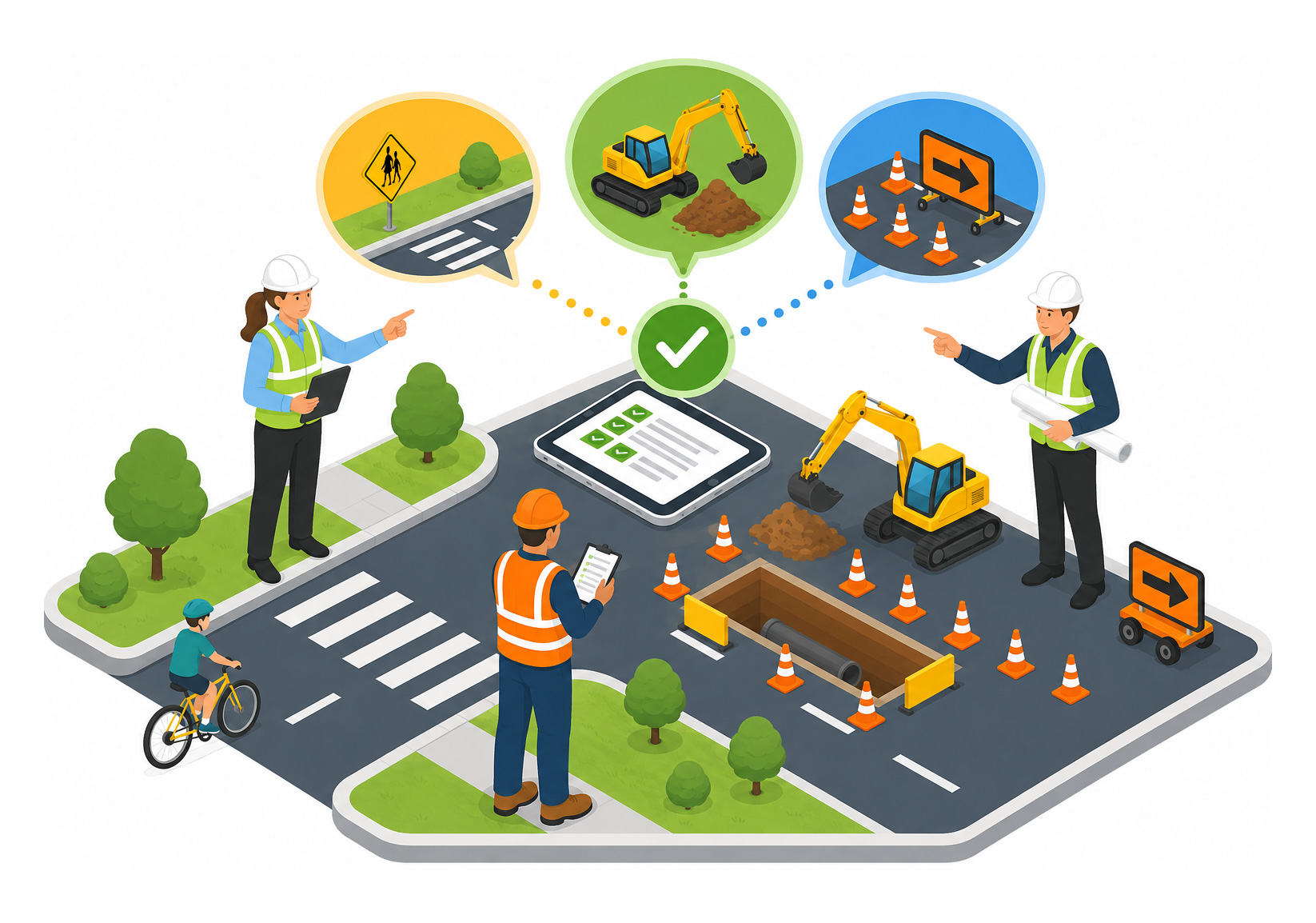
Under CoPTTM, compliance lived in the prescriptive layouts. If the diagram matched the code, you were covered. Under NZGTTM, compliance lives in the risk assessment, and a risk assessment is only as good as the conversations behind it.
This is where the 3Cs come in: consult, cooperate, coordinate.
The 3Cs aren't new
They come from the Health and Safety at Work Act 2015. Where more than one PCBU shares a work activity, each must consult, cooperate and coordinate with the others, so far as reasonably practicable. In corridor terms, that's the council, the principal contractor, subcontractors, the TTM provider, and sometimes the neighbouring RCA, all holding duties over the same stretch of road at the same time.
That duty has been sitting there since the Act came into force in 2015. What the NZ Guide did was make it load-bearing. With the prescriptive layouts gone, the conversations between duty holders are no longer good practice around the edges of compliance. They are the compliance.
You're already doing this
Here's the part that gets lost in transition guidance: these conversations are already happening on your network every week and have been for decades. The TMC who rings a contractor because two jobs are about to land on the same intersection. The pre-start email thread where someone flags the school crossing. The site visit where the methodology gets adjusted because the footpath is busier than anyone expected.
The industry isn't failing to consult. The problem is different, and it's twofold. First, it's not always clear which works genuinely need a conversation and which don't. Second, the conversations that do happen leave almost no trace.
Auckland Transport's TTM advisory team recently published observations from reviewing NZGTTM-era plans, and the pattern is telling. Risk assessments arrive missing, incomplete, or visibly written after the controls were already chosen. There's often no sign that any consultation shaped the outcome. Now, in some of those cases the conversation possibly never happened. But in plenty of others it did, over the phone or on site, and the record of those conversations looks exactly the same: blank.
There's a good reason the Act asks multiple parties to talk, and AT's observations illustrate it well. Every party has a natural focus. The contractor is thinking about the programme and cost. The TTM provider is thinking about the layout design. The council is thinking about network function and complaints. Each focus creates blind spots that only someone else at the table can see. No one person or entity assesses the whole risk picture alone. That's not a flaw, it's the entire reason the 3Cs exist.
What needs a conversation, and what doesn't
The 3Cs don't demand a workshop for every site. Proportionality is built into the Act, and pretending otherwise just buries the conversations that matter under ones that don't.
Routine, low-risk work with a single PCBU, on a quiet local road, using a methodology the parties have run together many times? A short confirmation may be a perfectly legitimate 3Cs interaction. Say what you're doing, confirm nothing's changed and, where appropriate, move on.
A genuine conversation is needed when:
- Multiple PCBUs are working on or adjacent to the same corridor at the same time
- The work interfaces with the state highway network or busy arterial
- Vulnerable road users are in play: schools, pedestrians, cycleways, mobility access
- The methodology is novel, or departs from industry standards
- Anything changes mid-works: methodology, duration, footprint, unattended states
- The work clashes with events, other programmes, or seasonal network pressure
Reasons why the 3Cs matter
Genuine consultation produces genuinely better outcomes. AT gave a good example from overhead works: a CoPTTM approach closes a long stretch of footpath for the whole day, while a properly consulted, risk-based approach runs a small moving closure that follows the actual work. Smaller footprint, less disruption, better compliance from road users because the controls make visible sense. Multiply that across a network and you get fewer clashes, fewer complaints, and controls people actually respect.
The second reason is the one nobody enjoys thinking about. If something goes wrong on a worksite, WorkSafe's investigators will ask each PCBU to show how they consulted, cooperated and coordinated. Not whether. How. And an undocumented conversation is, for practical purposes, indistinguishable from no conversation. For most RCAs the real exposure isn't that their people didn't talk. It's that when the question comes, nobody can show that they did.
What a good record looks like
It doesn't need to be long, but it needs to survive months or years after the event:
- Who was consulted, and when
- What risks each party raised, including the ones outside your own natural focus
- What was decided, and why that option over the alternatives
- What changed as a result, including changes mid-works
- Where the current version of truth lives
Most organisations can probably answer these questions for any given worksite, eventually. They're just scattered across inboxes, people's heads or meeting notes on someone's drive. The answers likely exist but organisations need to ensure that records are not lost when someone walks out the door or changes jobs.
When should we have the conversation?
The 3Cs are not a single point-in-time conversation. They are a continuous set of conversations which should start before a TMP is designed and continue throughout the delivery of work. A conversation that was adequate in week one may be well out of date by week six.
Any TMP designer worth their salt will have had conversations with the contractors, investigated the site and engaged with the road controlling authority and other impacted parties before they settle on the design of a TMP. When a TMP is deployed the STMS and crew should reassess and monitor the site, identifying and documenting risks and the mitigations or improvements they have implemented. Feedback and lessons learned are an important part of safety culture too.
Four questions worth asking your team
- If WorkSafe asked tomorrow for the 3Cs record behind one specific worksite, how long would it take to assemble, and how confident would you be in it?
- Would that record survive staff turnover?
- Are the conversations attached to the TMP they relate to, or floating somewhere near it?
- When something changed mid-works, did the record change with it?
The organisations answering these questions well haven't added a documentation chore on top of everyone's day. They've made the record a by-product of how the work already flows: the conversation should happen where the TMP lives, so evidencing it takes no extra effort at all.
The 3Cs were never really about paperwork. They're about the moment someone at the table says "actually, the school crossing is the problem here" before the cones go out, rather than after. The paperwork just proves the moment happened. Under the NZ Guide, that proof is now part of the job.
How myWorksites supports 3Cs
myWorksites gives you one place to hold the evidence of your 3Cs conversations.
The Early Access Request (EAR) process helps triage which sites may require deeper consultation with the RCA before a TMP is designed.
It does this by automatically assessing a range of factors within the EAR, giving it a score and recommending which stakeholders may need to be consulted. Critically it also allows low risk work to move directly to the design stage.
The review module in myWorksites supports 3Cs further by documenting evidence of meetings and communications, recording risks and assumptions along with any proposed methodologies discussed. By storing this information in one place it makes it easier to pick up these conversations later - meaning fewer surprises during the approval process.
For active sites we are currently consulting with industry on how we can support the collaboration between multiple road crews working in the same area and the RCA.
If you are interested in sharing your views or ideas on this please get in touch with us via our support team: support@myworksites.com